A frond does not always stay a frond. Sometimes, at its very tip, it changes its mind and becomes something else entirely.
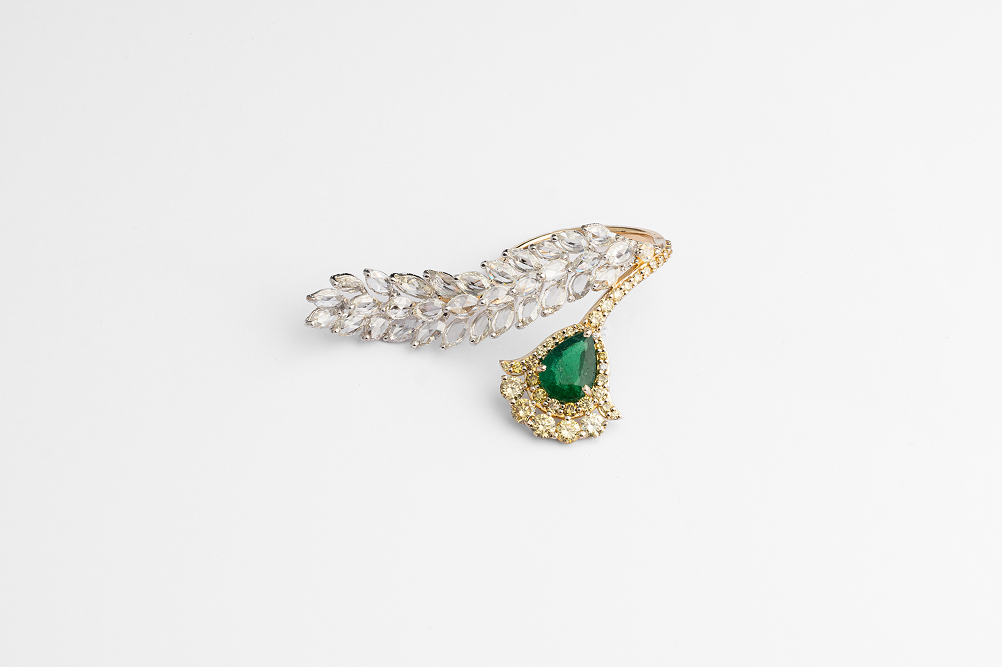
This ring carries a single spray of marquise diamonds up the hand in an unbroken sweeping line — the same fern vocabulary that opens Yield and closes Lineage — but instead of resolving into a bead cluster or a daisy head, it arrives at a small cupped blossom in gold, its petals rimmed in pavé, cradling one round emerald at the centre like dew caught at the exact moment a leaf decides to flower.
The transition is placed deliberately off-centre on the hand, not at the knuckle where a stone would simply sit, but angled across it, so the eye reads the piece as a single continuous gesture rather than two motifs joined at a seam. This is harder to set than a centred stone would be — the band must carry weight asymmetrically without ever feeling unbalanced on the finger.
Lineage told the story of a stem becoming a flower without changing direction. This piece tells the same story from the other side: the exact verge where one ends and the other begins.
PIECE DOSSIER
(internal reference — pending gemological confirmation)
| Element | Detail |
|---|---|
| Piece type | Ring |
| Design family | The fern-to-blossom ring, asymmetric setting — collection: Vanika, The Garden After Rain |
| Metal | Yellow gold blossom cup, white gold or platinum frond spray (confirm alloy with workshop) |
| Centre stone | Round green stone set within a petalled gold cup (emerald assumed — confirm with chief gemologist) |
| Primary stones | Marquise-cut white diamonds along the frond spray, pavé diamonds rimming the blossom petals |
| Sizing note | Asymmetric band weight — confirm comfort and sizing range with workshop |
SALON NOTE Hold the ring so the client sees it from the side first, not straight on — the asymmetric sweep reads as motion from that angle in a way the top-down view doesn’t show.